Glazing Challenge
Here is a structured 3-Day Glazing Challenge designed to build your
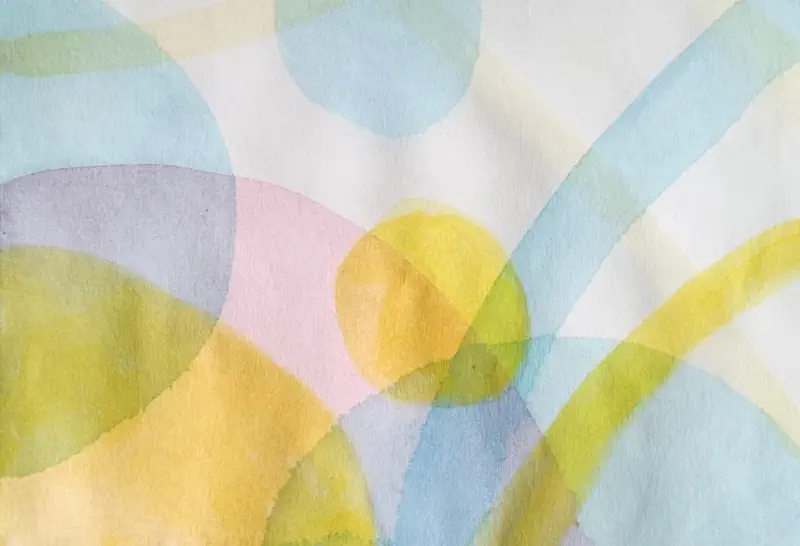
skills from basic control to a full abstract composition like the above
artwork. This challenge focuses on patience and transparency.
Preparation: The "Golden Rule"
Before you start, commit to this rule: "If it feels cool to the touch, it is
still wet. Do not paint over it."
•
Cheat Code: Use a hair dryer on a low, warm setting to speed up
drying time between layers.
Day 1: The "Puddle & Edge" Drill
Goal: Master paint consistency and the "hard edge" effect. Colours:
Pick 1 single color (e.g., Blue).
Mix Your "Tea": Mix your paint with water until it is very fluid (like weak
tea).
The Drop Test: Load your brush. Paint 5 separate circles on the page.
They should be wet enough that they form a small "dome" or puddle of
water on the paper, but not so wet that they run uncontrollably.
The Waiting Game: Let them dry naturally. Do not touch them.
The Result: Look at the dried circles.
Did you get a dark rim around the edge? Success! The pigment settled
at the perimeter.
•
Is it faint/chalky? Too much water, not enough pigment.
•
Is it streaky? Too dry, you need more water in the mix.
Day 2: The "Magic Math" (1 + 1 = 3)
Goal: Create new colours through layering (Glazing). Colours: Yellow,
Cyan (Light Blue), Magenta (Pink).
Row 1 (Green): Paint a Yellow square. Let it dry completely. Paint a
Blue square that overlaps the yellow one by 50%. Watch the overlap
turn bright Green.
Row 2 (Orange/Ochre): Paint a Yellow circle. Let it dry. Paint a Pink
circle overlapping it. Watch the overlap turn Orange/Peach.
Row 3 (Purple): Paint a Pink triangle. Let it dry. Paint a Blue triangle
overlapping it. Watch the overlap turn Violet.
Observation: Notice how the underlying shape's edge is still visible
through the top shape. This is the hallmark of the style in your image.
Day 3: The "Lyrical Flow" (Full Composition)
Goal: Recreate the style of your uploaded image using curves and
asymmetry. Colours: Your full palette.
Layer 1 (The Background shapes):
•
Paint 3 large, sweeping curves or giant circles in very pale
colours (lots of water).
•
Let these shapes run off the edge of the paper.
•
Allow to dry completely (bone dry).
Layer 2 (The Intersectors):
•
Mix slightly more pigment (stronger colour).
•
Paint new curves that cross over the first layer. Try to cross them
at interesting angles (like an X or a curve cutting through a circle).
•
Technique Tip: While one of these shapes is still wet, drop one
drop of clean water into the center of it. This will create the
"cauliflower/bloom" texture seen in the yellow circle of your
photo.
•
Allow to dry completely.
Layer 3 (The Accents):
•
Look for empty spaces or areas that feel unbalanced.
•
Add smaller geometric shapes or bands of colour to tie it
together.
•
Ensure these overlap previous layers to create those deep, rich
third colours.



Glazing Challenge
Here is a structured 3-Day Glazing Challenge
designed to build your skills from basic control to
a full abstract composition like the above artwork.
This challenge focuses on patience and
transparency.
Preparation: The "Golden Rule"
Before you start, commit to this rule: "If it feels
cool to the touch, it is still wet. Do not paint
over it."
•
Cheat Code: Use a hair dryer on a low, warm
setting to speed up drying time between
layers.
Day 1: The "Puddle & Edge" Drill
Goal: Master paint consistency and the "hard
edge" effect. Colours: Pick 1 single color (e.g.,
Blue).
Mix Your "Tea": Mix your paint with water until it
is very fluid (like weak tea).
The Drop Test: Load your brush. Paint 5 separate
circles on the page. They should be wet enough
that they form a small "dome" or puddle of water
on the paper, but not so wet that they run
uncontrollably.
The Waiting Game: Let them dry naturally. Do
not touch them.
The Result: Look at the dried circles.
•
Did you get a dark rim around the edge?
Success! The pigment settled at the
perimeter.
•
Is it faint/chalky? Too much water, not
enough pigment.
•
Is it streaky? Too dry, you need more
water in the mix.
Day 2: The "Magic Math" (1 + 1 = 3)
Goal: Create new colours through layering
(Glazing). Colours: Yellow, Cyan (Light Blue),
Magenta (Pink).
Row 1 (Green): Paint a Yellow square. Let it dry
completely. Paint a Blue square that overlaps the
yellow one by 50%. Watch the overlap turn bright
Green.
Row 2 (Orange/Ochre): Paint a Yellow circle. Let
it dry. Paint a Pink circle overlapping it. Watch the
overlap turn Orange/Peach.
Row 3 (Purple): Paint a Pink triangle. Let it dry.
Paint a Blue triangle overlapping it. Watch the
overlap turn Violet.
Observation: Notice how the underlying shape's
edge is still visible through the top shape. This is
the hallmark of the style in your image.
Day 3: The "Lyrical Flow" (Full
Composition)
Goal: Recreate the style of your uploaded image
using curves and asymmetry. Colours: Your full
palette.
Layer 1 (The Background shapes):
•
Paint 3 large, sweeping curves or giant
circles in very pale colours (lots of water).
•
Let these shapes run off the edge of the
paper.
•
Allow to dry completely (bone dry).
Layer 2 (The Intersectors):
•
Mix slightly more pigment (stronger
colour).
•
Paint new curves that cross over the first
layer. Try to cross them at interesting
angles (like an X or a curve cutting
through a circle).
•
Technique Tip: While one of these shapes
is still wet, drop one drop of clean water
into the center of it. This will create the
"cauliflower/bloom" texture seen in the
yellow circle of your photo.
•
Allow to dry completely.
Layer 3 (The Accents):
•
Look for empty spaces or areas that feel
unbalanced.
•
Add smaller geometric shapes or bands
of colour to tie it together.
•
Ensure these overlap previous layers to
create those deep, rich third colours.