Only the Mountain Remains
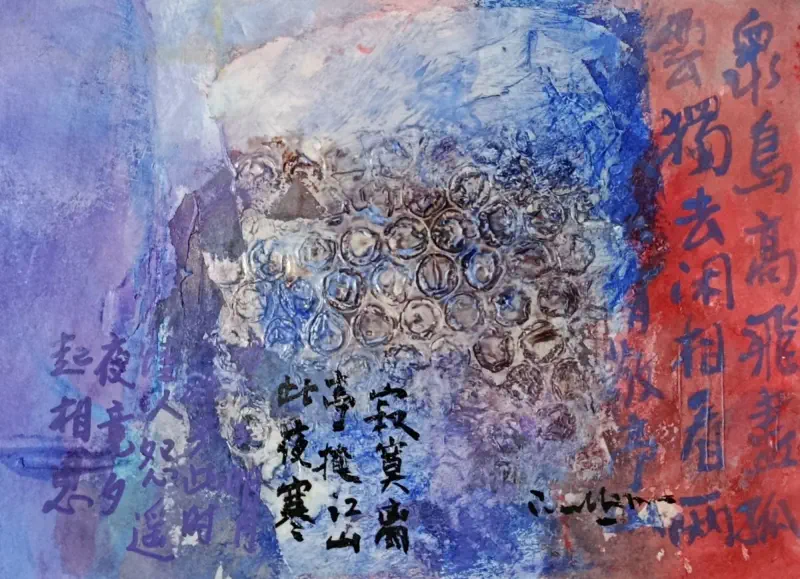
This work brings together the abstraction of colour and texture with the
timeless voices of classical Chinese poetry. Three poems appear on the
surface, each evoking solitude, longing, and reflection under the
presence of nature. Li Bai’s verse speaks of watching the mountain
after birds and clouds have departed, finding companionship in what
endures. Another line recalls the chill of a parting night, while Zhang
Jiuling’s moonlit poem opens a space of shared longing across vast
distances.
The painting’s visual language amplifies these emotions. Cool violets
and deep blues suggest the stillness of night and the ache of
separation, while the textured circular impressions resemble mountain
stones, ripples of water, or imprints of time itself. They ground the
viewer in the materiality of nature and memory. The area of striking red
introduces another dimension—solitude not as emptiness, but as
vitality, an inner fire of presence that continues even in loneliness.
Together, words and colours form a layered meditation. The poems
give voice to longing, the hues embody its moods, and the textures
preserve its weight and permanence. In this dialogue, solitude is not
desolation but companionship—the mountain, the moon, the
landscape stand as faithful witnesses to the human heart.
The title “Only the Mountain Remains 《唯有山在》” captures this
essence.
Poetic Reflection
Only the Mountain Remains
In the silence of night,
the birds have flown,
the clouds drift away—
yet the mountain stays.
Its rugged face holds the weight of longing,
its quiet strength carries the echo of verses.
Between red silence and purple night,
solitude is not emptiness,
but the companionship of stone, moon, and memory.



Only the Mountain Remains
This work brings together the abstraction of colour
and texture with the timeless voices of classical
Chinese poetry. Three poems appear on the surface,
each evoking solitude, longing, and reflection under
the presence of nature. Li Bai’s verse speaks of
watching the mountain after birds and clouds have
departed, finding companionship in what endures.
Another line recalls the chill of a parting night, while
Zhang Jiuling’s moonlit poem opens a space of
shared longing across vast distances.
The painting’s visual language amplifies these
emotions. Cool violets and deep blues suggest the
stillness of night and the ache of separation, while
the textured circular impressions resemble
mountain stones, ripples of water, or imprints of
time itself. They ground the viewer in the materiality
of nature and memory. The area of striking red
introduces another dimension—solitude not as
emptiness, but as vitality, an inner fire of presence
that continues even in loneliness.
Together, words and colours form a layered
meditation. The poems give voice to longing, the
hues embody its moods, and the textures preserve
its weight and permanence. In this dialogue,
solitude is not desolation but companionship—the
mountain, the moon, the landscape stand as faithful
witnesses to the human heart.
The title “Only the Mountain Remains 《唯有山在》”
captures this essence.
Poetic Reflection
Only the Mountain Remains
In the silence of night,
the birds have flown,
the clouds drift away—
yet the mountain stays.
Its rugged face holds the weight of longing,
its quiet strength carries the echo of verses.
Between red silence and purple night,
solitude is not emptiness,
but the companionship of stone, moon, and
memory.