Tears Beneath the Blossoms
This painting beautifully unites poetry, calligraphy, and painting, the
traditional “三绝” (three perfections) of Chinese literati art.
The red blossoms radiate vivid life, bold against the quiet background.
They symbolize vitality, transience, and the fleeting brilliance of
existence.
The background wash of greens and soft circular patterns creates a
dreamlike, timeless atmosphere — as if echoing the “vastness of
heaven and earth” mentioned in the verse.
The calligraphy anchors the painting in history and emotion. Chen
Ziang’s words express the loneliness of the thinker who feels the
immensity of time and space, and the fleeting nature of human life
within it.
In this visual-poetic dialogue, the blossoms become a poignant
counterpoint to the text: while the words mourn solitude and the
inexorable passage of time, the flowers assert the present moment’s
beauty — fragile, yet radiant.
The painting thus becomes not only a visual delight, but also a
meditation on existence, time, and presence. It reflects the classic
Chinese artistic aim: to weave together nature, emotion, and
philosophy into one breath.
Poetic Reflection
Tears Beneath in Blossoms
the poet’s words fall like shadows of time.
No ancients before, no followers behind —
only the vast breath of heaven and earth.
The petals burn briefly,
yet in their light,
a solitary heart releases its tears.
花下泪痕
诗句如时光的影子飘落。
前不见古人,后不见来者,
唯有天地悠悠的浩叹。
花瓣刹那燃烧,
在微光中,
孤独的心滴下清泪。



Tears Beneath the Blossoms
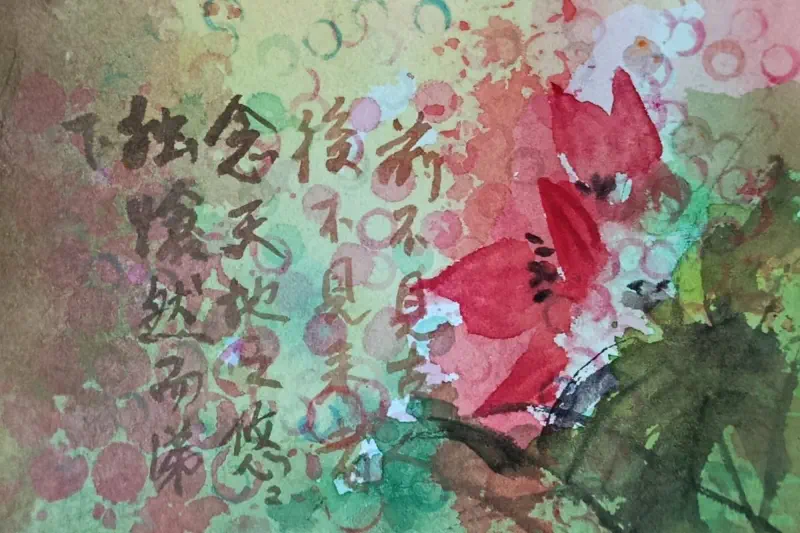
This painting beautifully unites poetry, calligraphy,
and painting, the traditional “三绝” (three
perfections) of Chinese literati art.
The red blossoms radiate vivid life, bold against the
quiet background. They symbolize vitality,
transience, and the fleeting brilliance of existence.
The background wash of greens and soft circular
patterns creates a dreamlike, timeless atmosphere
— as if echoing the “vastness of heaven and earth”
mentioned in the verse.
The calligraphy anchors the painting in history and
emotion. Chen Ziang’s words express the loneliness
of the thinker who feels the immensity of time and
space, and the fleeting nature of human life within
it.
In this visual-poetic dialogue, the blossoms become
a poignant counterpoint to the text: while the words
mourn solitude and the inexorable passage of time,
the flowers assert the present moment’s beauty —
fragile, yet radiant.
The painting thus becomes not only a visual delight,
but also a meditation on existence, time, and
presence. It reflects the classic Chinese artistic aim:
to weave together nature, emotion, and philosophy
into one breath.
Poetic Reflection
Tears Beneath in Blossoms
the poet’s words fall like shadows of time.
No ancients before, no followers behind —
only the vast breath of heaven and earth.
The petals burn briefly,
yet in their light,
a solitary heart releases its tears.
花下泪痕,
诗句如时光的影子飘落。
前不见古人,后不见来者,
唯有天地悠悠的浩叹。
花瓣刹那燃烧,
在微光中,
孤独的心滴下清泪。