Abstract Landscape Painting
Reliance on Colour and Form to Create a Composition
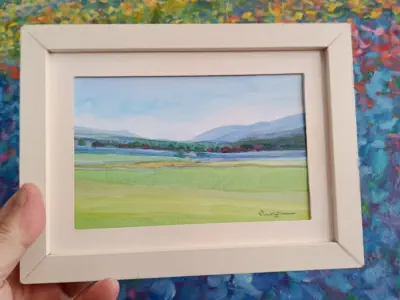
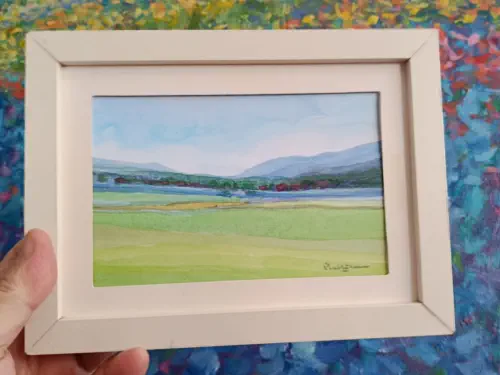
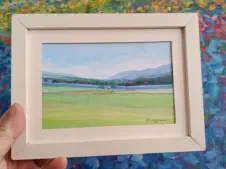
The above painting is a small-scale, framed watercolour landscape. It is
not entirely abstract; it depicts a recognizable scene of a hilly or
mountainous terrain with a foreground of fields. The composition is
built on distinct horizontal bands of colour and shape that represent
different elements of the landscape. At the bottom, a vibrant green
field gives way to a darker, more textured band of trees or shrubbery.
Beyond that, the middle ground features a distant line of hills, and the
background is a soft blue sky with a hint of clouds. The artist uses a
loose, painterly style, with the colours bleeding into one another, which
is a common characteristic of watercolour.
Comparison to the Earlier Painting
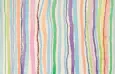
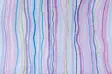
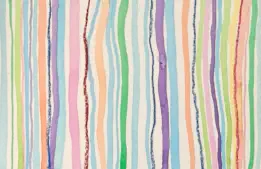
The most obvious difference between this landscape and the earlier
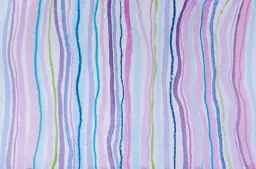
abstract piece is the subject matter. The previous painting was a non-
representational abstraction focused purely on the interplay of vertical
lines and colours, while this one is a representational landscape that,
while stylized, depicts a real-world scene.
•
Directional Focus: The previous painting was dominated by vertical
lines, creating a sense of upward movement and rhythm. In
contrast, this landscape is defined by its horizontal bands—the
fields, tree line, and hills—that lead the eye across the painting,
creating a sense of depth and a vast, open space.
•
Colour Use: Both paintings use a similar palette of greens, blues,
and purples, but they are applied for different purposes. In the
abstract work, colours are the main subject. In the landscape, they
serve to describe the natural world, with specific colors representing
grass, trees, sky, and mountains.
Similarities and the Connection to Abstract Landscape
Despite their differences in subject, these two paintings share a core
similarity: their reliance on colour and form to create a composition.
The horizontal bands in this landscape, though they represent fields
and mountains, are essentially a series of coloured shapes. This is
where the connection to abstract landscape painting becomes clear.
An abstract landscape often simplifies the natural world into its basic
forms, colours, and textures, removing realistic details to focus on the
feeling or essence of the place. This painting does something similar,
though on a less extreme level. The fields, for instance, are not painted
with individual blades of grass, but rather as broad strokes of light and
dark green. The mountains are simplified shapes of purple and blue.
This simplification of form is what makes the painting feel both like a
landscape and, at the same time, a composition of abstract shapes. The
artist uses the real world as a starting point, but the final piece is an
interpretation defined by blocks of colour and form, much like a purely
abstract work.
Chinese Version (中文版)
Link:
Rhythmic Lines & Harmonious Hues
Meditative Art of Lines 1
Meditative Art of Lines 2
Abstract Landscape Painting
A Moment of Presence



Abstract Landscape Painting
Reliance on Colour and Form to Create a
Composition
The above painting is a small-scale, framed
watercolour landscape. It is not entirely abstract; it
depicts a recognizable scene of a hilly or
mountainous terrain with a foreground of fields. The
composition is built on distinct horizontal bands of
colour and shape that represent different elements
of the landscape. At the bottom, a vibrant green
field gives way to a darker, more textured band of
trees or shrubbery. Beyond that, the middle ground
features a distant line of hills, and the background is
a soft blue sky with a hint of clouds. The artist uses a
loose, painterly style, with the colours bleeding into
one another, which is a common characteristic of
watercolour.
Comparison to the Earlier Painting
The most obvious difference between this
landscape and the earlier abstract piece is the
subject matter. The previous painting was a non-
representational abstraction focused purely on the
interplay of vertical lines and colours, while this one
is a representational landscape that, while stylized,
depicts a real-world scene.
•
Directional Focus: The previous painting was
dominated by vertical lines, creating a sense of
upward movement and rhythm. In contrast, this
landscape is defined by its horizontal bands—the
fields, tree line, and hills—that lead the eye
across the painting, creating a sense of depth
and a vast, open space.
•
Colour Use: Both paintings use a similar palette
of greens, blues, and purples, but they are
applied for different purposes. In the abstract
work, colours are the main subject. In the
landscape, they serve to describe the natural
world, with specific colors representing grass,
trees, sky, and mountains.
Similarities and the Connection to Abstract
Landscape
Despite their differences in subject, these two
paintings share a core similarity: their reliance on
colour and form to create a composition. The
horizontal bands in this landscape, though they
represent fields and mountains, are essentially a
series of coloured shapes. This is where the
connection to abstract landscape painting becomes
clear.
An abstract landscape often simplifies the natural
world into its basic forms, colours, and textures,
removing realistic details to focus on the feeling or
essence of the place. This painting does something
similar, though on a less extreme level. The fields,
for instance, are not painted with individual blades
of grass, but rather as broad strokes of light and
dark green. The mountains are simplified shapes of
purple and blue. This simplification of form is what
makes the painting feel both like a landscape and, at
the same time, a composition of abstract shapes.
The artist uses the real world as a starting point, but
the final piece is an interpretation defined by blocks
of colour and form, much like a purely abstract
work.
Chinese Version (中文版)
Link:
Rhythmic Lines & Harmonious Hues
Meditative Art of Lines 1
Meditative Art of Lines 2
Abstract Landscape Painting
A Moment of Presence